|
We
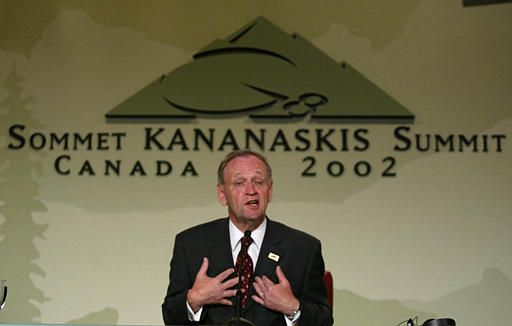
met in Kananaskis for our annual Summit to discuss the challenges of fighting
terrorism, strengthening global economic growth and sustainable development,
and building a new partnership for Africa's development.
This
was our first meeting since the terrible events of September 11. We discussed
the threat posed to innocent citizens and our societies by terrorists
and those who support them.
- We are committed
to sustained and comprehensive actions to deny support or sanctuary
to terrorists, to bring terrorists to justice, and to reduce the threat
of terrorist attacks.
- We agreed on
a set of six non-proliferation Principles aimed at preventing terrorists
- or those who harbour them - from acquiring or developing nuclear,
chemical, radiological and biological weapons; missiles; and related
materials, equipment or technologies. We called on other countries
to join us in implementing these Principles.
- We launched a
new G8 Global Partnership Against the Spread of Weapons and Materials
of Mass Destruction, under which we will undertake cooperative
projects on the basis of agreed guidelines. We committed to raise
up to US$ 20 billion to support such projects over the next ten years.
- We agreed on
a new initiative with clear deadlines - Cooperative G8 Action
on Transport Security - to strengthen the security and efficiency
of the global transportation system.
We
discussed the outlook for global economic growth and employment, and the
challenges of poverty reduction and sustainable development. We expressed
confidence in our economies and in the prospects for global growth. We
agreed on the fundamental importance of strong political leadership for
the success of economic reforms in our own economies. We support emerging
market countries, including Brazil and others in Latin America, in their
efforts to implement sound economic policies.
- We agreed to
resist protectionist pressures and stressed our commitment to work
with developing countries to ensure the successful conclusion of the
Doha Development Agenda by January 1, 2005.
- We agreed on
the importance of reaffirming the Doha Agenda and the Monterrey Consensus
and to work at the upcoming Johannesburg Summit to produce meaningful
partnerships for sustainable development and measurable results. We
recognized that climate change is a pressing issue that requires a
global solution, and we discussed the problem of deforestation.
- We will fund
our share of the shortfall in the enhanced HIPC initiative, recognizing
that this shortfall will be up to US $1 billion. We stressed the importance
of good governance in countries benefiting from HIPC debt relief.
- We reviewed implementation
of the DOT Force's Genoa Plan of Action and welcomed its initiatives
to strengthen developing countries' readiness for e-development, such
as the e-model to improve the efficiency of public administrations
and to enhance the transparency of national budgeting.
- We adopted a
series of recommendations to assist developing countries to achieve
universal primary education for all children and equal access to education
for girls. We agreed to increase significantly our bilateral assistance
for countries that have demonstrated a strong and credible policy
and financial commitment to these goals.
We
met with the Presidents of Algeria, Nigeria, Senegal and South Africa,
and the Secretary General of the United Nations, to discuss the challenges
faced by Africa and the G8's response to the New Partnership for Africa's
Development (NEPAD).
- We adopted the
G8 Africa Action Plan as a framework for action in support of
the NEPAD. We agreed to each establish enhanced partnerships with
African countries whose performance reflects the NEPAD commitments.
- Assuming strong
African policy commitments, and given recent assistance trends, we
believe that in aggregate half or more of our new development assistance
commitments announced at Monterrey could be directed to African nations
that govern justly, invest in their own people and promote economic
freedom.
- We underlined
the devastating consequences for Africa's development of diseases
such as malaria, tuberculosis and HIV/AIDS. In addition to our ongoing
commitments to combat these diseases, we committed to provide sufficient
resources to eradicate polio by 2005.
- We agreed to
work with African partners to deliver a joint plan by 2003 for the
development of African capability to undertake peace support operations.
- We will continue
our dialogue with our African partners. At our next Summit, we will
review progress on the implementation of the G8 Africa Action
Plan on the basis of a final report from our Personal Representatives
for Africa.
Finally,
we discussed several regional issues that have significant implications
for international peace and security.
- We stressed our
commitment to work for peace in the Middle East, based on our vision
of two states, Israel and Palestine, living side by side within secure
and recognized borders. We agreed on the urgency of reform of Palestinian
institutions and its economy, and of free and fair elections.
- We support the
Transitional Authority of Afghanistan. We will fulfil our Tokyo Conference
commitments and will work to eradicate opium production and trafficking.
- We discussed
the tensions between India and Pakistan. We agreed that Pakistan must
put a permanent stop to terrorist activity originating from territory
under its control. Both countries should commit to sustained dialogue
on the underlying issues that divide them.
We
welcomed the offer of the President of France to host our next Summit
in June 2003. We agreed that Russia will assume the 2006 G8 Presidency
and will host our annual Summit that year.
|


 KANANASKIS SUMMIT